The History of PUBG: From a Mod to a Global Phenomenon (2017–2026)
In the landscape of modern gaming, few titles have redefined an entire genre as profoundly as PlayerUnknown’s Battlegrounds (PUBG). What started as an experimental modification for a military simulation game has, by March 2026, transformed into a $15 billion empire with over 1.75 billion downloads worldwide.
This is the story of how a self-taught Irish developer named Brendan Greene changed the way the world plays.
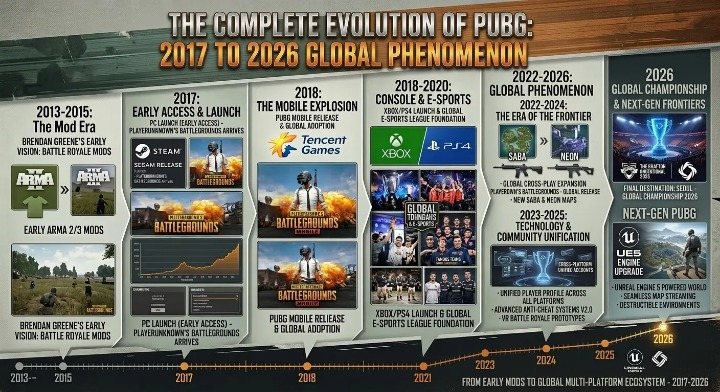
1. The Origins: The Vision of “PlayerUnknown”
The story of PUBG begins not in a high-tech studio, but in the bedroom of Brendan Greene in 2013. Living in Brazil and working as a freelance photographer and web designer, Greene was a casual gamer who found traditional shooters like Call of Duty too predictable. He wanted a game where the “unknown” was the primary enemy.
Inspired by the 2000 Japanese cult-classic film Battle Royale, Greene began modding ARMA 2 and later ARMA 3. He introduced a simple, brutal concept: 100 players, one island, and a shrinking “blue zone” that forced survivors into a final, bloody confrontation. Under the pseudonym “PlayerUnknown,” his mods became a massive underground hit.
The Call from Korea
After consulting on H1Z1: King of the Kill, Greene received an email that would change everything. Chang-han Kim, then an executive at the South Korean studio Bluehole (now Krafton), had been watching Greene’s work. He invited Greene to Korea to build a standalone version of his vision. This was a historic move; it was the first time a Korean studio had hired a Westerner for a lead creative role.
2017: The Year the World Dropped In
On March 23, 2017, PlayerUnknown’s Battlegrounds entered Early Access on Steam. Despite being unpolished and riddled with bugs, the game’s core loop—loot, survive, win—was an instant addiction.
September 2017: PUBG broke the record for the most concurrent players on Steam, surpassing giants like Dota 2 and CS:GO.
December 20, 2017: The PC 1.0 version officially launched, introducing the desert map Miramar alongside the original Erangel.
January 2018: The game hit an unprecedented peak of 3.2 million concurrent users.
PUBG didn’t just sell copies; it created a new cultural language. Phrases like “Winner Winner Chicken Dinner” and the silhouette of the Level 3 Helmet became icons of the decade.
2018–2021: The Mobile Revolution
While the PC version proved the concept, PUBG Mobile turned it into a global religion. Launched on March 19, 2018, and developed in collaboration with Tencent’s Lightspeed & Quantum Studio, the mobile version was a technical miracle. It managed to fit the massive 8×8 km Erangel map into the palm of a hand.
The Indian Context: From Ban to BGMI
Nowhere was the game more impactful than in India. PUBG Mobile single-handedly sparked the mobile esports boom in the country. However, the journey was rocky:
September 2020: The Indian government banned the game due to national security concerns.
May 2021: Krafton relaunched the game specifically for the Indian market as Battlegrounds Mobile India (BGMI), ensuring local data sovereignty and establishing India as a standalone gaming powerhouse.
2022–2025: Transition to Free-to-Play & The “New Era”
As competition from Fortnite, Apex Legends, and Warzone grew, PUBG underwent its most significant business shift. On January 12, 2022, the game transitioned to a Free-to-Play model. This move revitalized the player base, bringing in millions of new users who had previously been hesitant about the $29.99 price tag.
By 2025, the game had fully embraced its identity as a “Platform.” It introduced User-Generated Content (UGC) through the World of Wonder (WOW) mode, allowing players to build their own maps and game rules, much like Roblox or Minecraft.
2026: The State of the Game Today
As we celebrate the 8th Anniversary of the mobile launch this month, PUBG remains a top-tier global title. The current v4.3 “Evolving Universe” update represents the “New Era” of the franchise.
Key Milestones of 2026:
1.75 Billion Downloads: PUBG Mobile is officially one of the top 3 most-downloaded games in history.
Esports Shift to TPP: In a bold move for the 2026 Roadmap, the professional scene has officially transitioned to Third-Person Perspective (TPP) to align closer with the 1 billion casual players who prefer that view.
The Specialization System: The introduction of RPG-like roles (Medic, Recon, Tactician) has added a layer of strategy that wasn’t possible in 2017.
Conclusion: The Legacy of Erangel
PUBG’s history is more than just a list of updates. It is the story of how realism, high stakes, and a simple “one-life” mechanic captured the human imagination. Brendan Greene has since moved on to build a 3D digital world called Artemis, but his legacy—the 100-player survival struggle—remains the gold standard for competitive gaming.
Whether you’re jumping into Pochinki for the first time or the ten-thousandth, the adrenaline of that final circle remains unchanged.